TL;DR
A mid-level hire in Canada costs $95,000–$130,000 fully loaded. An AI system that does the same repetitive work costs $15,000–$40,000 to build and $3,000–$8,000/year to run. For roles that are more than 60% repetitive task work, automation wins on ROI every time — usually within 6 months. Here's the complete breakdown and the framework for deciding which path to take.
The Fully-Loaded Cost of a Hire (That Nobody Talks About)
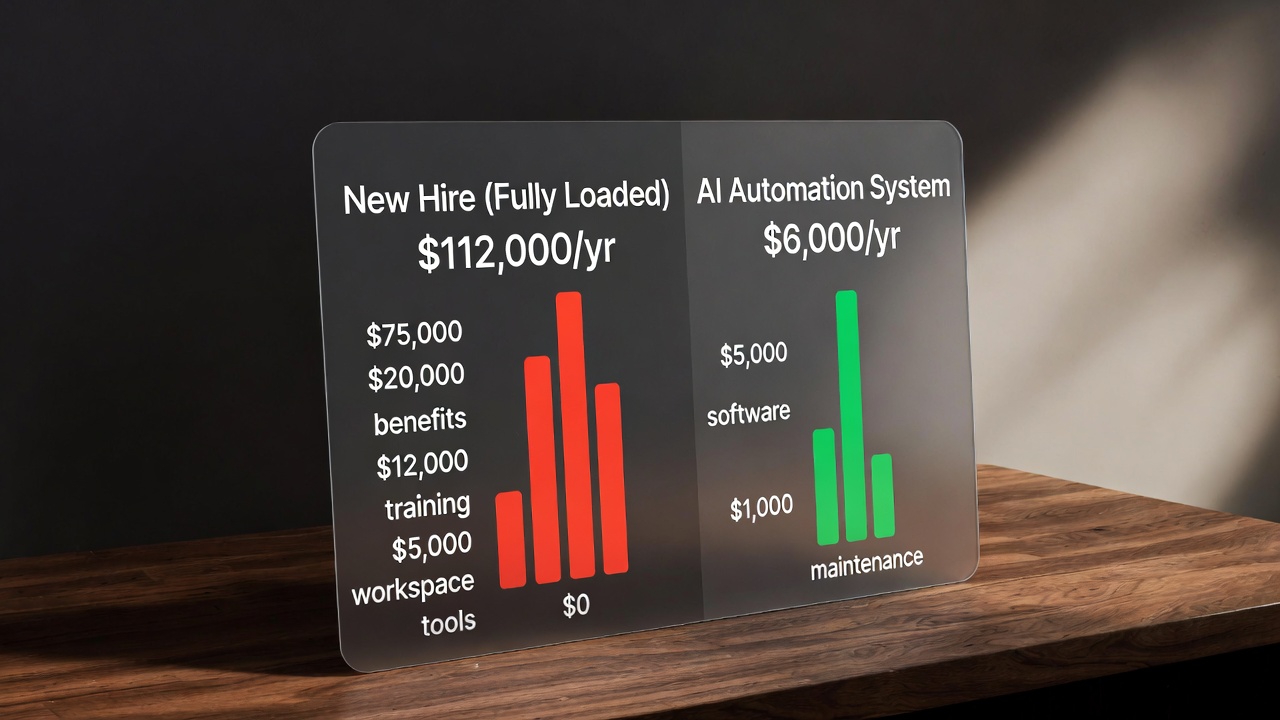
Salary is the number founders and operators fixate on. It's also the least useful number for decision-making. The fully-loaded cost of a hire — what that person actually costs your business each year — is typically 1.4–1.7x their base salary.
Here's the breakdown for a mid-level operations or admin hire at $60,000 base salary in Canada:
| Cost Component | Annual Cost (CAD) |
|---|---|
| Base salary | $60,000 |
| CPP employer contribution (~5.95%) | $3,570 |
| EI employer contribution (~2.28%) | $1,368 |
| Benefits (health, dental, vision — ~8%) | $4,800 |
| Vacation pay (3 weeks standard) | $3,461 |
| Equipment (laptop, software licences, peripherals) | $3,500 |
| Office space / desk (if applicable — $500/desk/month) | $6,000 |
| Recruitment cost (1 month salary, amortised over 3 years) | $1,667 |
| Onboarding and training (est. 4 weeks at full salary) | $4,615 |
| Management overhead (~10% of a manager's time) | $8,000 |
| Total fully-loaded annual cost | ~$97,000 |
That's $97,000/year for someone earning $60,000. And that's before accounting for the soft costs: the distraction of managing performance reviews, the risk of turnover (average tenure in admin/ops roles: 2.3 years), the cost of re-hiring and re-onboarding when they leave.
For a senior hire at $90,000 base, the fully-loaded cost reaches $135,000–$155,000/year.
What AI Automation Systems Actually Cost
The cost of an AI automation system has three components: build cost (one-time), tool costs (monthly recurring), and maintenance (ongoing).
Build Cost
Ranges from $5,000 (simple single-workflow automation) to $45,000 (complex multi-system, AI-enabled workflow). Most business process automations fall in the $10,000–$25,000 range for a complete, production-ready system.
Tool Costs (Monthly Recurring)
- n8n (self-hosted): $0–$50/month hosting
- OpenAI / Anthropic API: $50–$500/month depending on volume
- Data enrichment (Apollo, Clay): $50–$200/month
- Sending infrastructure (Instantly, Smartlead): $97–$297/month
- Vector database (Pinecone): $0–$70/month
- Typical total: $200–$800/month ($2,400–$9,600/year)
Maintenance
2–4 hours/week of internal team time (valued at $30–$80/hour depending on who manages it). Annual maintenance cost: $3,000–$16,000. Well-built systems require less maintenance; complex multi-system automations require more.
Total Annual Cost of an AI System
For a system replacing one FTE's repetitive work — amortising build cost over 3 years:
- Build cost amortised: $5,000–$15,000/year
- Tool costs: $2,400–$9,600/year
- Maintenance: $3,000–$16,000/year
- Total: $10,400–$40,600/year
The Side-by-Side Comparison
| Metric | New Hire ($60K base) | AI Automation System |
|---|---|---|
| Year 1 cost | $97,000 | $30,000–$55,000 (incl. build) |
| Year 2 cost | $97,000 | $5,400–$25,600 |
| Year 3 cost | $97,000 | $5,400–$25,600 |
| 3-year total cost | $291,000 | $40,800–$106,200 |
| Capacity (volume) | 170 hrs/month productive | Unlimited (scales horizontally) |
| Hours of operation | ~160 hrs/month (business hours) | 8,760 hrs/year (24/7) |
| Error rate (data entry) | 2–18% (varies by task) | 0.5–2% (with review layer) |
| Turnover risk | High (avg. 2.3 year tenure) | None |
| 3-year savings vs. hire | — | $184,800–$250,200 |
The 3-year savings range of $185,000–$250,000 compared to a single $60K hire should be legible to any operator. For a team that's considering 3 new hires to handle scale, the math becomes extraordinary — and the case for automation becomes structurally compelling.
Calculate your specific ROI.
Book a free 30-minute call. We'll run the numbers for your specific roles, volume, and team, and tell you whether automation or hiring is the better financial decision.
ROI Timeline: When Does Automation Pay Back?
Payback period varies based on two factors: how much the automation costs to build, and how much labour it replaces. Here are three representative scenarios:
Scenario A: Single Workflow Automation ($12,000 build)
Replaces 15 hours/week of admin work at $35/hour fully-loaded. Annual labour saved: $27,300. Ongoing automation cost: $4,800/year. Net annual savings: $22,500. Payback period: 6.4 months.
Scenario B: Full Role Automation ($22,000 build)
Replaces a $55,000 base ($85,000 fully-loaded) admin/coordinator role. Ongoing automation cost: $8,400/year. Net annual savings: $76,600. Payback period: 3.4 months.
Scenario C: Department Automation ($45,000 build)
Replaces 3 support agents ($75,000 fully-loaded each, $225,000 total). Ongoing automation cost: $18,000/year. Net annual savings: $207,000. Payback period: 2.6 months.
Notice the pattern: the larger the automation scope, the shorter the payback period. This is because fixed build costs amortise across a larger labour saving. High-volume, high-repetition roles produce the fastest ROI.
Roles to Automate First
Not all roles are equal candidates for automation. The best automation candidates share a profile:
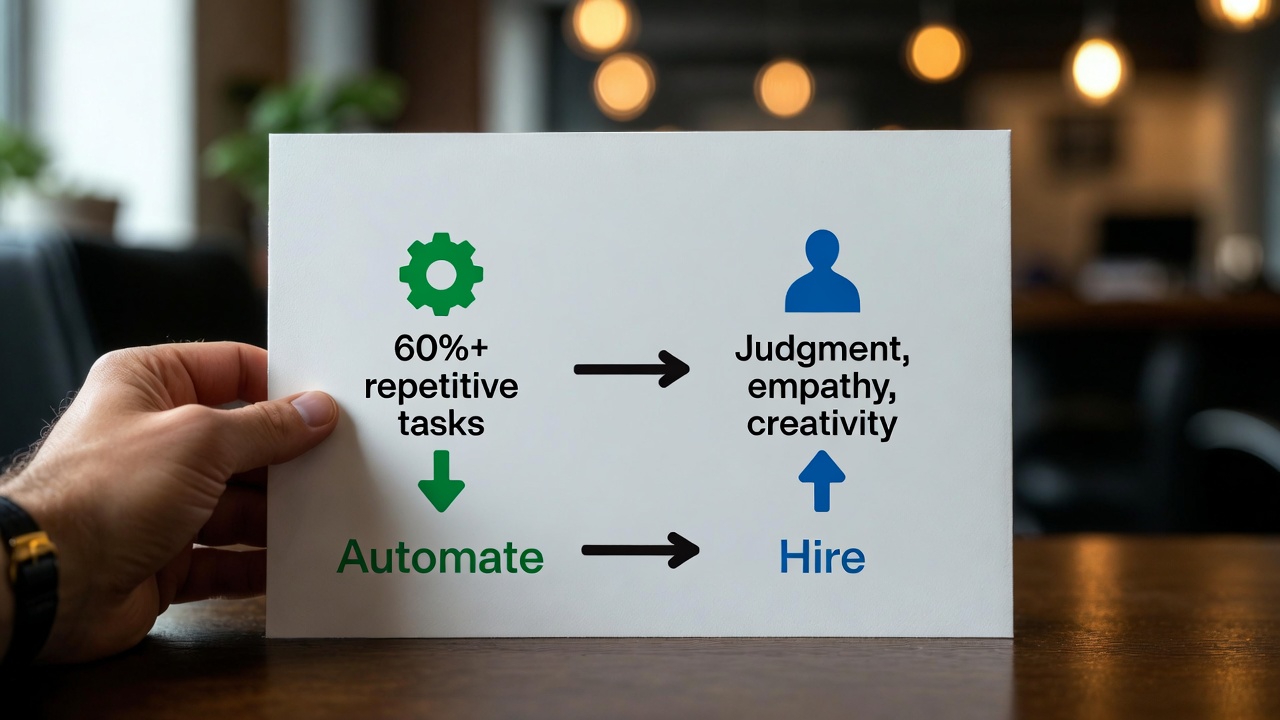
- High proportion of repetitive tasks — more than 60% of work time on recurring, predictable activities
- Well-defined rules — the work follows clear decision logic that can be documented
- High volume — the workflow runs frequently enough that automation overhead is negligible relative to scale
- Structured inputs/outputs — information comes in a consistent format and produces a consistent output
Ranked by automation ROI, the best candidates in most businesses:
- Customer support (Tier 1) — question answering, order status, account information, policy questions
- Data entry and admin — invoice processing, CRM updates, report generation, form processing
- Outbound sales development — lead research, outreach, follow-up sequences, calendar booking
- Marketing operations — content repurposing, social scheduling, email sequence management, analytics reporting
- Finance operations — accounts payable processing, expense categorisation, reconciliation
When Hiring Wins
This isn't an argument that you should never hire. Hiring wins when:
- The work is predominantly judgment-based — creative strategy, relationship management, complex problem-solving, novel situations that don't fit rules. AI is not good at these yet, at the quality level that builds lasting client relationships.
- You need someone to own accountability — some roles require a human who is personally invested in outcomes and bears professional accountability for results. AI systems don't have careers at stake.
- The domain is highly regulated — healthcare, legal, and financial advice roles where regulatory liability requires a licensed human professional
- Culture and leadership — you can't automate the person who inspires your team, who makes the hard call in a crisis, who builds trust with a key customer over years. Those people are irreplaceable and worth paying well.
The ideal operating model in 2025: a smaller, higher-quality human team focused on strategy, relationships, and judgment, with AI systems handling the high-volume, repetitive substrate that those humans would otherwise be buried under.
FAQs
What if we have existing employees in roles that could be automated?
This is a nuanced conversation that goes beyond ROI. The most successful approach we've seen: automate the repetitive components of a role, and redeploy the freed capacity toward higher-value work — customer relationships, process improvement, creative output. This creates leverage for the existing employee rather than replacing them. The "automate to replace" model has a place in specific situations, but "automate to level up" tends to produce better outcomes for the business and for team morale.
Are these numbers applicable to US businesses?
The framework applies universally. The specific numbers shift — US salaries at the equivalent roles are typically 15–25% higher than Canadian equivalents, and benefits costs differ by state. US businesses also face higher turnover costs on average. The net effect is that the automation ROI is typically even stronger in US markets than the CAD figures above suggest.
How do AI systems handle the judgment calls that fall outside their rules?
They escalate. Every automation we build has a defined escalation path — anything outside the rules, anything above a confidence threshold, anything flagged as high-stakes — gets routed to a human immediately with full context. The system is designed to handle the 80% confidently and escalate the 20% that requires judgment, rather than attempting the 20% poorly. The human time savings come from eliminating the 80%, not from replacing 100%.
What's the first step if we want to explore this?
Book a free 30-minute call with LoopSuit. We'll ask you about your team structure, the roles you're considering hiring for, and the repetitive tasks consuming the most time in your business. We'll give you a plain-English answer on whether automation makes financial sense for your situation, and if yes, what it would cost and what it would save. No pitch decks, no pressure — just a real conversation about the numbers.